
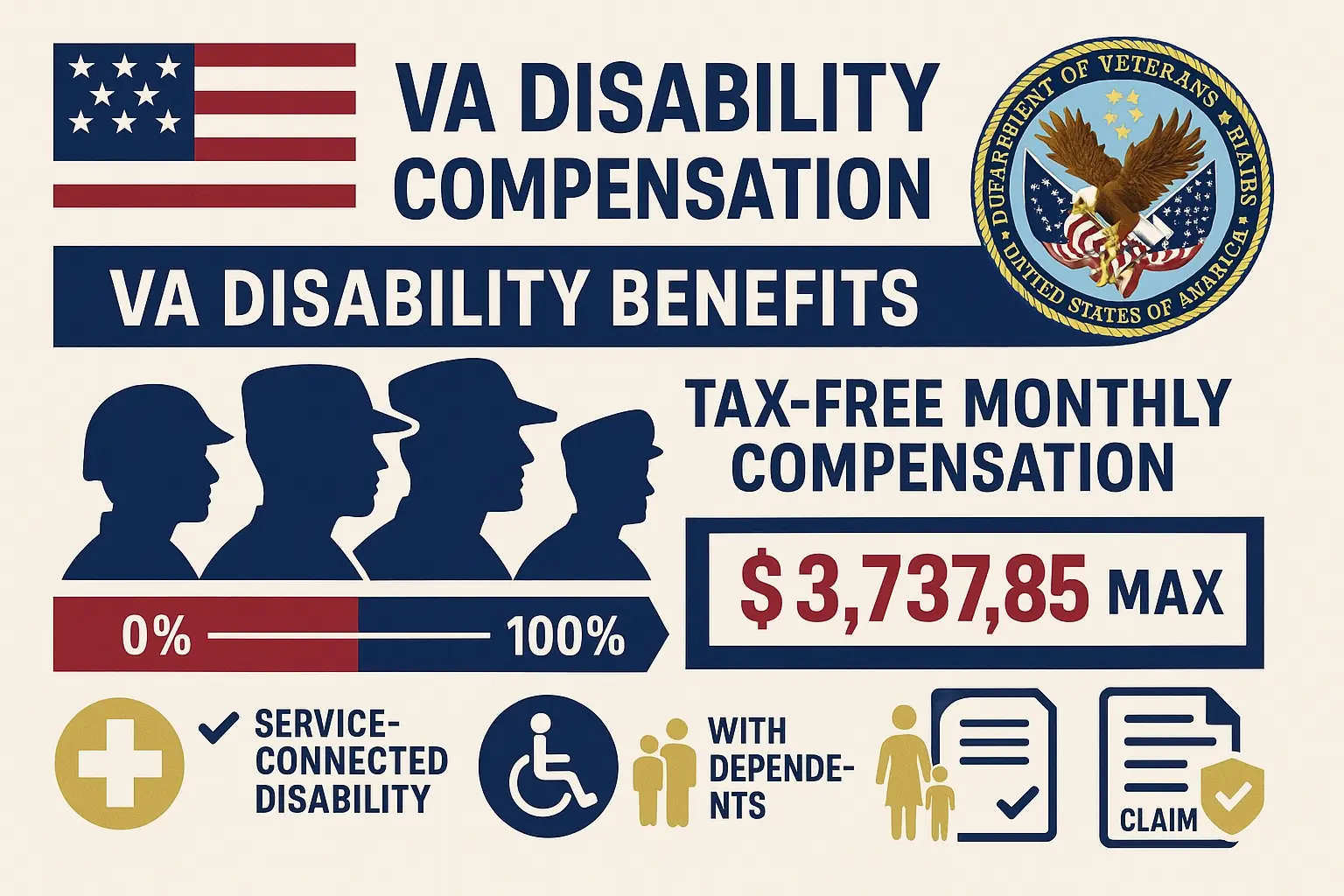
The Department of Veterans Affairs provides disability compensation to veterans who become sick, injured, or experience an existing condition that worsens because of military service. This program offers tax-free monthly payments based on a disability rating that reflects the condition's severity and impact on daily activities and employment.
VA disability benefits extend beyond financial assistance. Compensation may also give veterans access to healthcare, vocational support, and other VA benefits designed to improve quality of life. In some cases, dependent children, spouses, or parents may receive additional compensation to help cover their needs. Eligible surviving spouses and family members may also qualify for benefits if the veteran has passed away.
For many veterans and their families, disability compensation provides stability after military service. It recognizes the challenges that arise from service-connected disabilities and ensures that support is available when health conditions create long-term limitations.
Eligibility Requirements for VA Disability Compensation
To qualify for VA disability compensation, veterans must meet certain baseline requirements related to their health, service, and the link between them. Eligibility focuses on whether a veteran’s condition is connected to military service, the type of discharge received, and the evidence to support the claim.
Basic Criteria to Qualify for Disability Benefits
- The veteran must have a current illness, injury, or condition affecting the body or mind.
- The condition must have been caused by, or made worse during, active military service.
- Service must include active duty, active duty for training, or inactive duty training.
- Supporting documents, such as medical evidence or service records, must show how the condition is connected to military service.
Service-Connected Disabilities
The VA recognizes several ways a disability can be linked to service:
- Direct service connection: This applies when a condition clearly resulted from events, injuries, or illnesses during military service.
- Presumptive service connection: This applies when certain chronic illnesses or exposure-related conditions are assumed to be caused by service if a veteran served in specific locations or time periods. Examples include illnesses tied to Agent Orange, Gulf War Syndrome, or burn pit exposure.
- Secondary service connection: This applies when a disability develops because of an existing condition already recognized as service-connected. For instance, a back injury that later causes arthritis or depression may qualify as a secondary disability.
Discharge Status and Service Requirements
Eligibility also depends on discharge status. Veterans who received a discharge under conditions other than dishonorable are generally eligible for disability benefits. In some situations, the VA may review cases with less favorable discharge types to determine whether the person may still qualify.
Service-Connected Disabilities and VA Disability Benefits
Service-connected disabilities are conditions that the VA determines were caused or made worse by military service. Recognizing these disabilities allows veterans to access VA disability benefits, which may include monthly compensation, healthcare, and additional benefits for eligible dependents. The VA evaluates physical and mental health conditions, certain chronic illnesses, and exposure-related conditions.
Types of Disabilities Covered by the VA
The VA considers a wide range of disabilities when reviewing a claim:
- Physical conditions: These include injuries such as back or joint problems, hearing loss, or respiratory issues that can be traced to events during service.
- Mental health conditions: Veterans may qualify for compensation if they experience post-traumatic stress disorder, depression, anxiety, or other service-related mental health conditions.
- Chronic illness: Long-term illnesses, such as diabetes, certain heart conditions, or autoimmune diseases, may be covered if linked to service.
- Exposure-related conditions: Veterans who were exposed to hazards like Agent Orange, burn pits, or radiation may qualify for compensation if they develop related diseases.
Presumptive Conditions and Groups of Veterans
Veterans sometimes do not need to prove that their condition was caused directly by service. The VA maintains lists of presumptive conditions, meaning that if a veteran served in a specific place or time, the condition is automatically presumed to be service-connected.
- Vietnam War veterans: Certain cancers and other illnesses are linked to Agent Orange exposure.
- Gulf War veterans: Conditions such as Gulf War Syndrome and other chronic multi-symptom illnesses may qualify.
- Post-9/11 veterans: Exposure to burn pits has led to respiratory and other long-term health conditions.
- Former prisoners of war: Various physical and mental health conditions may be presumed service-connected.
- Radiation-exposed veterans: Certain cancers and related illnesses may be presumed due to documented exposure.
How to File a VA Disability Claim
Filing a VA disability claim requires careful preparation and attention to detail. Veterans must gather supporting documents, select a filing method, and complete required forms. The VA reviews each claim to determine whether benefits are granted and what disability rating applies.
Step-by-Step Process for Filing a Disability Claim
- Gather supporting documents: Collect service treatment records, medical records, and any additional evidence that links the condition to service.
- Complete VA Form 21-526EZ: This standard claim form is required to begin the process.
- Submit the claim: Veterans may file online, by mail, or in person at a regional VA office.
- Attend a Compensation and Pension (C&P) exam: The VA may schedule this exam, sometimes called VA rounds, to evaluate the disability.
- Wait for claim decision: The VA will review all evidence and determine the proper disability rating.
Required Documentation and Supporting Evidence
Complete records and statements support a strong claim:
- Military service records: The DD-214 and other service records confirm military history.
- Medical records: Service treatment records and private healthcare documentation show how conditions developed or worsened.
- Supporting documents: Letters from family, friends, or fellow service members can provide valuable context.
- Additional information: Employment history and impact on daily life may help establish severity.
Filing Methods for VA Disability Claims
Veterans can file a disability claim in several ways, depending on their preference and access to resources:
- Online through VA.gov: This is the recommended method for efficiency and tracking.
- Mail: Claims may be sent to the appropriate regional office for processing.
- In person: Veterans can visit a VA regional office for assistance.
- Through representation: A claims agent or an accredited attorney can help prepare and submit the application, ensuring all necessary evidence is included.
Submitting a complete claim with thorough documentation increases the likelihood of a clear and accurate claim decision. Veterans who obtain new evidence can request a review to update their disability rating.
Understanding the VA Disability Rating System
The VA disability rating system measures how much a service-connected disability affects a veteran’s ability to work and carry out daily activities. Ratings are expressed as percentages, starting at 0 percent and increasing in increments of 10 up to 100 percent. The higher the rating, the greater the monthly compensation and access to additional benefits.
The VA Disability Rating Scale
Disability ratings are based on the severity of a condition. The following table provides a simplified overview:
This scale helps the VA determine the appropriate level of disability compensation for each individual.
Combined Rating System and Bilateral Factor
When a veteran has more than one service-connected disability, the VA uses a combined rating system rather than simply adding percentages together. The formula is designed so the final combined rating never exceeds 100 percent.
- Combined disability rating: This refers to the percentage determined by combining multiple disabilities using the VA’s calculation method.
- Final combined rating: This is the VA's official number to determine monthly pay. For example, a veteran with 50 percent and 30 percent ratings will not automatically receive an 80 percent rating. Instead, the combined rating system adjusts the result.
- Bilateral factor: If a veteran has disabilities affecting both arms, legs, or paired organs, the VA may increase the rating to account for the greater overall impact.
The VA rating process may seem complex, but it ensures that multiple conditions are considered fairly. Veterans can request a review if they believe the severity of their conditions is not accurately reflected in the assigned rating.
VA Disability Compensation Rates
The amount of disability compensation a veteran receives depends on the assigned disability rating and whether they have dependents. Rates are adjusted annually to reflect cost-of-living increases. In addition to basic pay, veterans may qualify for additional compensation if they have dependent children, a spouse, or dependent parents.
2024 VA Disability Compensation Rates by Rating and Dependents
The following table shows the 2024 monthly compensation rates for veterans. Amounts increase when dependents are included.
These rates reflect the veteran’s final combined rating. Payment increases are available when there are additional dependents, such as an additional child, an additional schoolchild, or dependent parents.
Special Monthly Compensation and Additional Benefits
Some veterans may be eligible for more than standard disability compensation:
- Special Monthly Compensation (SMC): This is paid to veterans with severe disabilities, such as loss of limbs, blindness, or a need for regular aid and attendance.
- Additional compensation for dependents: Veterans with dependent children, a spouse, or dependent parents may receive higher monthly pay.
- Support for survivors: Eligible surviving spouses and survivors may qualify for indemnity compensation if the veteran’s death was service-related.
These factors, which include dependents, severity of disability, and special needs, allow the VA compensation system to adjust benefits to the individual situation. This approach helps ensure that veterans and their families receive support that reflects their circumstances.
VA Disability vs. Social Security Disability Benefits
VA disability and Social Security Disability Insurance (SSDI) are two separate programs that provide financial assistance to people with health conditions. Veterans may qualify for both, but the programs have different eligibility rules, rating systems, and payment structures. Understanding the distinctions helps veterans know what to expect and whether they can benefit from both systems.
Key Differences Between VA Benefits and SSDI
Although both VA disability and Social Security Disability Insurance provide financial assistance, the programs operate under very different rules. VA benefits are based on service-connected disabilities, while SSDI eligibility depends on work history and the inability to perform substantial employment. Veterans may qualify for both, but the requirements and outcomes are not the same.
- Eligibility: VA disability compensation is available to veterans with conditions linked to military service. SSDI is available to individuals who have worked long enough to pay Social Security taxes and who cannot perform substantial gainful activity.
- Disability rating: The VA assigns a disability rating from 0 percent to 100 percent in 10 percent increments, while SSDI makes an all-or-nothing determination with no percentage scale.
- Work restrictions: Veterans can often continue working while receiving VA disability benefits. In contrast, SSDI recipients generally cannot work at a level considered substantial gainful employment.
- Healthcare access: Veterans with VA benefits may receive care through the VA healthcare system. SSDI recipients qualify for Medicare, but only after 24 months of benefit payments.
- Tax status: VA disability compensation is tax-free at both the federal and state levels, whereas SSDI benefits may be taxable depending on household income.
These differences highlight why many veterans apply for both types of assistance. VA disability benefits acknowledge the impact of service-connected conditions, while SSDI provides broader support for those who are unable to work due to any disabling condition.
Concurrent Receipt and Indemnity Compensation
Some veterans may qualify for both VA benefits and Social Security Disability Insurance at the same time. This is called concurrent receipt. However, military retirement pay may be reduced unless the veteran qualifies for programs such as Concurrent Retirement and Disability Pay (CRDP) or Combat-Related Special Compensation (CRSC).
In addition to concurrent receipt, certain family members may qualify for indemnity compensation. This benefit supports surviving spouses, dependent children, or dependent parents if a veteran’s death was linked to service-connected conditions.
The VA Disability Claim Decision and Appeals Process
Once a disability claim is submitted, the VA reviews all evidence to determine whether benefits are approved and what disability rating applies. The outcome of this review is called the claim decision. Veterans who disagree with the decision have the right to appeal through several available channels.
Understanding the Claim Decision Process
When the VA issues a claim decision, it provides several key pieces of information:
- The decision explains whether the condition is considered service-connected.
- The decision states the disability rating, which reflects the severity of the condition and how it affects daily life.
- The decision identifies the effective date of compensation and the monthly payment amount.
If an existing condition becomes worse over time, veterans may file a request for an updated review to increase their disability rating.
Appeals and Requests for Review
Veterans who disagree with a claim decision have three primary options under the Appeals Modernization Act:
- Higher-Level Review: A senior reviewer reexamines the claim using the same evidence previously submitted.
- Supplemental Claim: The veteran provides new evidence or additional information to support the case.
- Board Appeal: The claim is sent to the Board of Veterans’ Appeals, which may involve hearings and additional evidence.
Timelines vary. Higher-Level Reviews and Supplemental Claims generally take several months, while Board Appeals often take more than a year.
Representation in the Appeals Process
Veterans are not required to appeal alone. Representation is available through accredited attorneys, claims agents, or Veterans Service Organizations. These representatives can help gather new evidence, prepare arguments, and ensure that the appeal is filed correctly. Professional support can make the process more manageable, particularly for complex cases.
Special VA Benefits and Programs
In addition to standard disability compensation, the VA offers special programs that provide additional benefits to veterans and their families. These programs recognize the unique challenges faced by those with severe disabilities or long-term limitations and are designed to offer support beyond basic monthly payments.
Total Disability Based on Individual Unemployability (TDIU)
TDIU provides compensation at the 100 percent disability rate to veterans who cannot maintain substantially gainful employment because of service-connected disabilities, even if their combined rating is below 100 percent. This program ensures that veterans whose conditions prevent steady work receive the same level of support as those with a total disability rating.
Vocational Rehabilitation and Employment (VR&E)
VR&E, also known as Chapter 31 benefits, helps veterans with service-connected disabilities prepare for, find, and keep suitable employment. The program may cover job training, education, resume development, and counseling services. For veterans unable to work, VR&E can also provide support for independent living.
Dependents’ Educational Assistance (DEA)
DEA, or Chapter 35 benefits, offer education and training opportunities to eligible dependents of veterans who are permanently and totally disabled because of a service-connected condition. Benefits may be used for degree programs, apprenticeships, or vocational training, helping family members pursue long-term goals.
Housing Grants and Additional Benefits
The VA also provides housing-related assistance for veterans with severe disabilities:
- Specially Adapted Housing (SAH) grants allow veterans to build, buy, or remodel homes to meet their accessibility needs.
- Special Housing Adaptation (SHA) grants provide funds for modifications to an existing home.
- Veterans may also qualify for aid, attendance, or other additional benefits if their conditions require ongoing personal care.
These programs extend VA benefits beyond standard disability compensation, addressing the practical needs of veterans and dependents whose lives are significantly shaped by service-connected conditions.
VA Benefits Resources and Support
Veterans and their families have access to various resources designed to make the disability compensation process more manageable. These services help applicants find accurate information, submit claims correctly, and obtain support during reviews or appeals.
Official VA Contact Information
- The VA National Call Center can be reached at 1-800-827-1000 for questions about claims and benefits.
- The VA website, VA.gov, offers online claim filing, status tracking, and information about disability compensation.
- The eBenefits portal provides tools to review claim status, download documents, and manage benefits.
- A VA mobile app is available for iOS and Android, allowing quick access to claim information.
Regional Offices
The VA operates regional offices across the United States. Veterans can visit these offices to file a claim in person, provide supporting documents, or request assistance. Office locations are listed through the VA’s facility locator tool.
Veterans Service Organizations
Many Veterans Service Organizations, or VSOs, offer free assistance with disability claims. These groups provide trained representatives who can guide applicants through the process. Notable organizations include:
- Disabled American Veterans (DAV)
- Veterans of Foreign Wars (VFW)
- The American Legion
- Paralyzed Veterans of America
- Vietnam Veterans of America
Access to these resources ensures that veterans, dependents, and survivors can get reliable support throughout the disability claim and appeals process.
Strong supporting documents include military service records, service treatment files, and private medical evidence. Statements from healthcare providers linking a condition to service are valuable. Additional information, such as employment records or letters from family members, can also demonstrate the condition’s impact. A complete and well-organized submission increases the chances of receiving an accurate and timely claim decision from the VA.


