
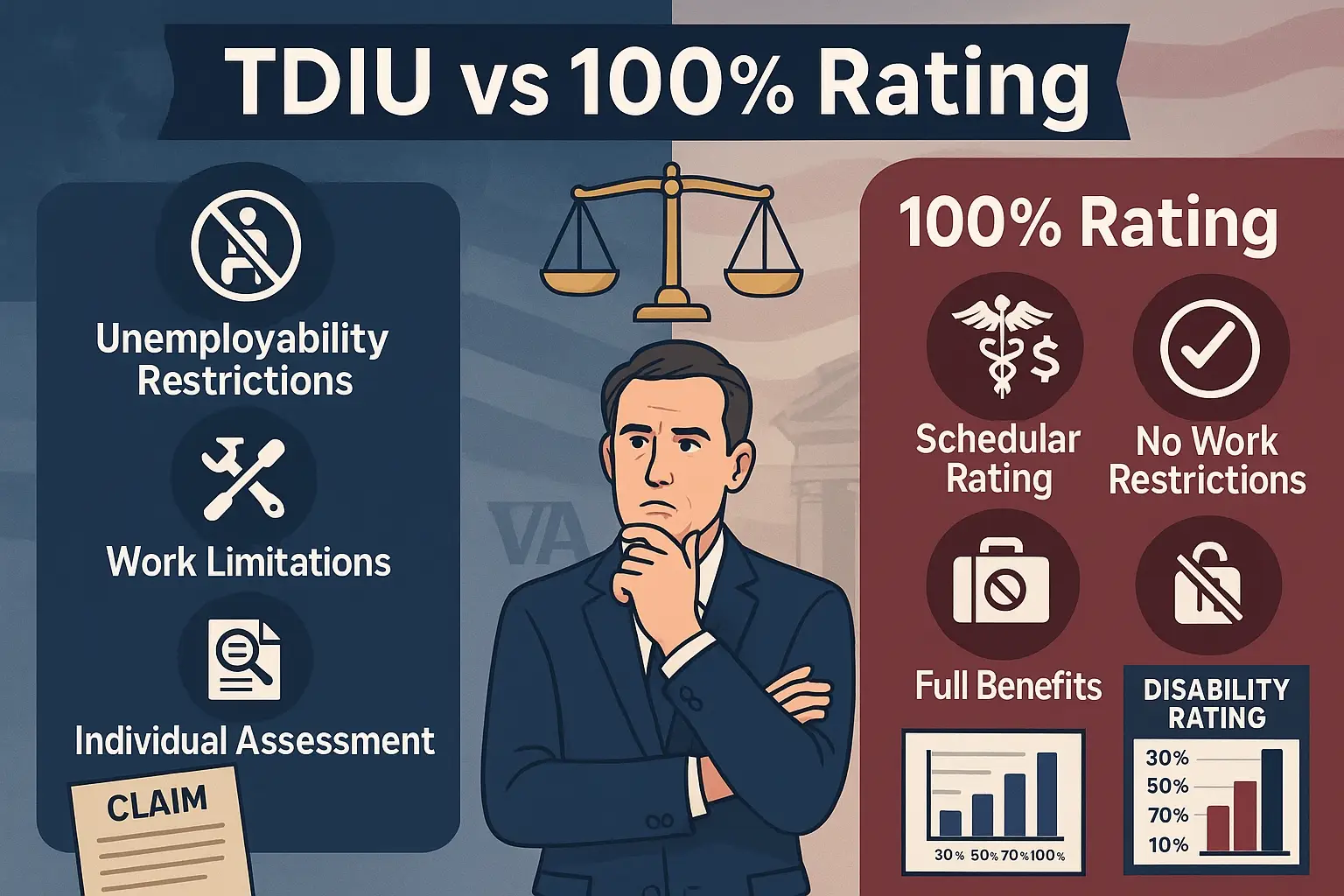
Veterans seeking VA disability benefits often face two main paths to receive the highest level of disability compensation: Total Disability based on Individual Unemployability (TDIU) and a 100 percent disability rating. Both have the same monthly payment amount, but the eligibility requirements, restrictions, and long-term outcomes differ.
A disability claim for either option is based on a service-connected disability that prevents full participation in work or daily activities. Some veterans qualify through individual unemployability because they cannot maintain substantially gainful employment even with a lower disability rating. Others meet the criteria for a 100 percent schedular rating, which reflects the severity of a service-connected condition under the VA rating schedule.
These benefits are available to veterans with physical conditions, mental health conditions such as post-traumatic stress disorder, and chronic illnesses. Dependents, including a surviving spouse or dependent children, may also become eligible for certain types of support tied to these ratings, such as dependency and indemnity compensation. For many veterans and families, the distinction between TDIU and a 100 percent disability rating can make a significant difference in available benefits and daily life.
Understanding VA Disability Ratings and Disability Compensation
A VA disability rating is the percentage the Department of Veterans Affairs assigns to reflect how much a service-connected condition affects a veteran’s ability to work and function. Ratings range from 0 to 100 percent in 10 percent increments. The higher the rating, the greater the disability compensation a veteran receives each month.
How Disability Ratings Are Determined
- The VA uses the Schedule for Rating Disabilities to evaluate physical and mental health conditions.
- Each condition is matched with criteria that measure severity and impact on daily life.
- If a veteran has more than one service-connected disability, the combined ratings table calculates an overall rating.
- Sometimes, a disability claim may result in a temporary 100 percent rating, such as after surgery or recovery from a serious injury.
Disability Compensation and Eligibility
Disability compensation is not limited to veterans with visible injuries. It also covers chronic illness, post-traumatic stress disorder, and other conditions that may not appear immediately after military service. A veteran may file a claim when a condition worsens or new evidence supports service connection. Dependents may qualify for additional benefits in some instances, and survivors may become eligible for dependency and indemnity compensation.
The claims process often requires medical evidence, service records, and supporting documents. Veterans must submit forms by mail, online, or in person. If the VA issues a decision that the veteran disagrees with, the decision review process allows them to request further evaluation and provide more evidence to support the claim.
What is Individual Unemployability (TDIU) in VA Disability Benefits?
Definition and Purpose
Individual unemployability, commonly called TDIU, allows a veteran to receive disability compensation at the 100 percent rate even when their combined disability rating is below that level. This option is designed for veterans whose service-connected disabilities make it impossible to maintain substantially gainful employment. In practice, it recognizes that a disability rating does not always reflect the full impact of a condition on employability.
Schedular TDIU (38 CFR § 4.16(a))
A veteran may qualify for schedular TDIU if they have one service-connected disability rated at least 60 percent or multiple service-connected disabilities with at least one rated 40 percent and a combined rating of 70 percent or higher. In either situation, the veteran must demonstrate that their disabilities prevent them from holding steady work that provides more than marginal employment.
Extraschedular TDIU (38 CFR § 4.16(b))
Even veterans who do not meet the schedular thresholds may be considered for extraschedular TDIU. In these cases, the Department of Veterans Affairs reviews the claim to determine whether the veteran’s service-connected conditions prevent gainful work. Strong medical evidence, detailed employment records, and supporting documents are often required. This path ensures that veterans with severe physical conditions, mental health conditions such as post-traumatic stress disorder, or a chronic illness, can still obtain full disability benefits when their disabilities limit their ability to work.
What is a 100 Percent Service-Connected Disability Rating
Single 100 Percent Rating
A veteran may receive a 100 percent disability rating when one service-connected condition meets the criteria for total impairment under the VA Schedule for Rating Disabilities. This level of rating reflects a condition so severe that it is considered completely disabling on its own. Examples include advanced cancer under treatment, certain respiratory diseases, or a severe mental health condition such as post-traumatic stress disorder that prevents normal functioning.
Combined Ratings Using the VA Table
Many veterans have more than one service-connected disability. In these cases, the Department of Veterans Affairs applies the combined ratings table to determine whether the overall impact equals 100 percent. This table does not add percentages directly but instead calculates the effect of multiple conditions together. A veteran with several moderate disabilities may reach a total rating of 100 percent if the combined evaluation shows that the overall impact is completely disabling.
Temporary 100 Percent Ratings
The VA also grants temporary 100 percent disability ratings in certain situations. These include recovery from surgery, hospitalization lasting more than 21 days, or an unstabilized condition that requires close monitoring. A veteran may hold a temporary total rating while recovering and then return to a lower evaluation once the condition stabilizes. These temporary ratings provide crucial disability compensation during times when a veteran is unable to work due to treatment or recovery from a service-connected injury or illness.
How to File a Disability Claim for TDIU or 100 Percent Rating
Applying for TDIU with VA Form 21-8940
A veteran who cannot maintain substantially gainful employment due to service-connected disabilities may apply for individual unemployability using VA Form 21-8940. This form asks for employment history, education, training, and the ways a disability prevents work. Veterans must also request that former employers complete VA Form 21-4192, which provides information about job duties, work restrictions, and reasons for leaving employment.
When filing for TDIU, supporting documentation is important. This can include:
- Medical evidence showing how the service-connected condition prevents employment
- Vocational rehabilitation records, if available
- Statements from employers, family members, or others who can describe the impact of the disability
Applying for a 100 Percent Disability Rating with VA Form 21-526EZ
A claim for a schedular 100 percent disability rating is filed on VA Form 21-526EZ. This form is used for initial applications and requests for increased compensation based on an existing condition that has worsened. Veterans may file online through VA.gov, by mail, or in person at a regional office.
Required documents typically include:
- Service treatment records to show the origin of the disability
- Private or VA medical records that confirm the current severity of the condition
- Nexus letters or opinions linking the condition to military service
- Any new evidence that supports the claim
The Claims Process
Once submitted, the Department of Veterans Affairs reviews the application and medical evidence. Veterans may be scheduled for a Compensation and Pension (C&P) examination to evaluate the condition. The VA then issues a decision letter, which includes the assigned disability rating and effective date. If a veteran disagrees with the outcome, they may use the decision review process to file an appeal, request a higher-level review, or submit more evidence.
Comparison of VA Disability Benefits: TDIU vs 100 Percent
Monthly Disability Compensation
Both TDIU and a 100 percent schedular disability rating provide the same basic monthly compensation. As of 2024, the rate for a veteran with no dependents is $3,737.85. This amount increases if the veteran has dependents, such as a surviving spouse, dependent children, or a parent. Payments are adjusted annually to reflect cost-of-living increases.
Additional Veterans Disability Benefits
While the monthly compensation is the same, the benefits tied to each status can differ.
Employment Restrictions
The most significant difference between the two paths is the limitation on employment. A veteran receiving TDIU cannot engage in substantially gainful employment, although marginal employment may be allowed. By contrast, a veteran with a 100 percent schedular disability rating may continue to work without any impact on their disability benefits. This distinction is often a deciding factor for veterans considering which path better suits their situation.
Pros and Cons of VA Benefits: Individual Unemployability vs 100 Percent Rating
Individual Unemployability (TDIU)
TDIU allows veterans with service-connected disabilities to receive disability compensation at the 100 percent rate even when their disability rating is lower. This can provide important financial support, but it also comes with certain limitations.
Advantages
- TDIU allows veterans with lower disability ratings to qualify for the highest level of compensation.
- It can protect veterans from rating reductions if their medical conditions remain stable.
- Veterans receiving TDIU still gain access to most VA benefits, including healthcare and commissary privileges.
Disadvantages
- Veterans receiving TDIU cannot work in substantially gainful employment, though marginal employment is permitted.
- Dependents are not eligible for educational assistance programs tied to TDIU.
- Veterans may be required to complete yearly employment and income verification.
- Dental benefits are limited compared to those provided under a 100 percent schedular rating.
100 Percent Disability Rating
A 100 percent schedular rating represents total disability under the VA system. It offers the most comprehensive package of veterans' disability benefits, but it can be harder to qualify for than TDIU.
Advantages
- Veterans with a 100 percent disability rating may continue to work without restrictions.
- Dependents are eligible for educational assistance through VA programs.
- Veterans with a schedular rating receive complete dental care and other VA benefits.
- Continuous ratings at 100 percent for 20 years or more are generally protected from reduction.
- Additional grants for housing and adaptive equipment may be available.
Disadvantages
- Meeting the medical criteria for a 100 percent rating often requires more extensive evidence.
- Many veterans must go through multiple disability claims and appeals before reaching this rating.
- Ratings may be subject to reexamination unless they meet the criteria for protection.
- It can be more difficult to qualify for a schedular rating than TDIU.
Case Examples of Service-Connected Disabilities
Post-Traumatic Stress Disorder
A veteran with post-traumatic stress disorder rated at 70 percent also has tinnitus rated at 30 percent. The combined ratings table gives them an 80 percent disability rating. Because the mental health condition prevents steady employment, this veteran may qualify for TDIU even though the rating is less than 100 percent.
Back Injury and Multiple Conditions
A veteran has a back injury rated at 50 percent, a knee condition rated at 30 percent, and hearing loss rated at 20 percent. Together, the combined ratings equal 70 percent. If the back injury and other physical conditions prevent full-time work, the veteran may qualify for TDIU based on the inability to secure substantially gainful employment.
Single Condition at 100 Percent
A veteran with a service-connected condition such as advanced diabetes requiring daily insulin may qualify for a schedular 100 percent disability rating. With this rating, the veteran is not restricted from working and remains eligible for full VA disability benefits, including dependents’ educational assistance.
VA Disability Appeals and the Decision Review Process
When the Department of Veterans Affairs issues a decision that a veteran disagrees with, the decision review process provides several options for continuing the disability claim. Veterans can choose the path that best matches their situation, depending on whether they have new evidence, want a higher-level review, or wish to appeal to the Board of Veterans’ Appeals.
Higher-Level Decision Review
A higher-level review allows a more senior VA adjudicator to reexamine the claim. No new evidence can be submitted, but the review ensures the original decision was made correctly. Veterans file this option using VA Form 20-0996.
Supplemental Claim with New Evidence
A supplemental claim is used when veterans have new evidence to support their disability claim. This might include updated medical evidence, records that were not available earlier, or statements that clarify the impact of a service-connected condition. Veterans file a supplemental claim using VA Form 20-0995.
Board of Veterans’ Appeals
If a veteran disagrees with the outcome of either a higher-level review or a supplemental claim, they may appeal to the Board of Veterans’ Appeals. This step requires VA Form 10182, the Notice of Disagreement. The veteran can choose between a direct review, submitting more evidence, or requesting a hearing at this stage.
Court of Appeals for Veterans Claims
After a board decision, veterans may seek review in the Court of Appeals for Veterans Claims. This court examines legal or procedural errors in the VA’s handling of the disability claim. Although new evidence is not considered, this process ensures the VA applies the law correctly.
Helpful VA Benefits Resources for Veterans
The Department of Veterans Affairs provides multiple resources to help veterans, dependents, and survivors navigate the claims process. These resources can assist with filing new claims, obtaining more evidence, or requesting a decision review if a veteran disagrees with an outcome.
Key resources include:
- VA.gov: This is the main website for filing and tracking disability claims, accessing official forms, and reviewing up-to-date information on VA benefits.
- eBenefits: This is an online portal where veterans can view the status of disability claims, check compensation payments, and monitor any pending claim activity.
- Accredited Representatives and Veterans Service Organizations (VSOs): These are trained advocates who assist veterans with preparing, submitting, and appealing claims at no cost.
- VA Regional Offices: These are local offices where veterans may file documents in person, obtain answers about their disability claim, and receive guidance on the claims process.
These resources provide information on disability compensation, training, education, dependency and indemnity compensation, and benefits available to surviving spouses, dependent children, or parents. Accessing official sources and accredited support helps ensure veterans receive the benefits they are eligible for.


