
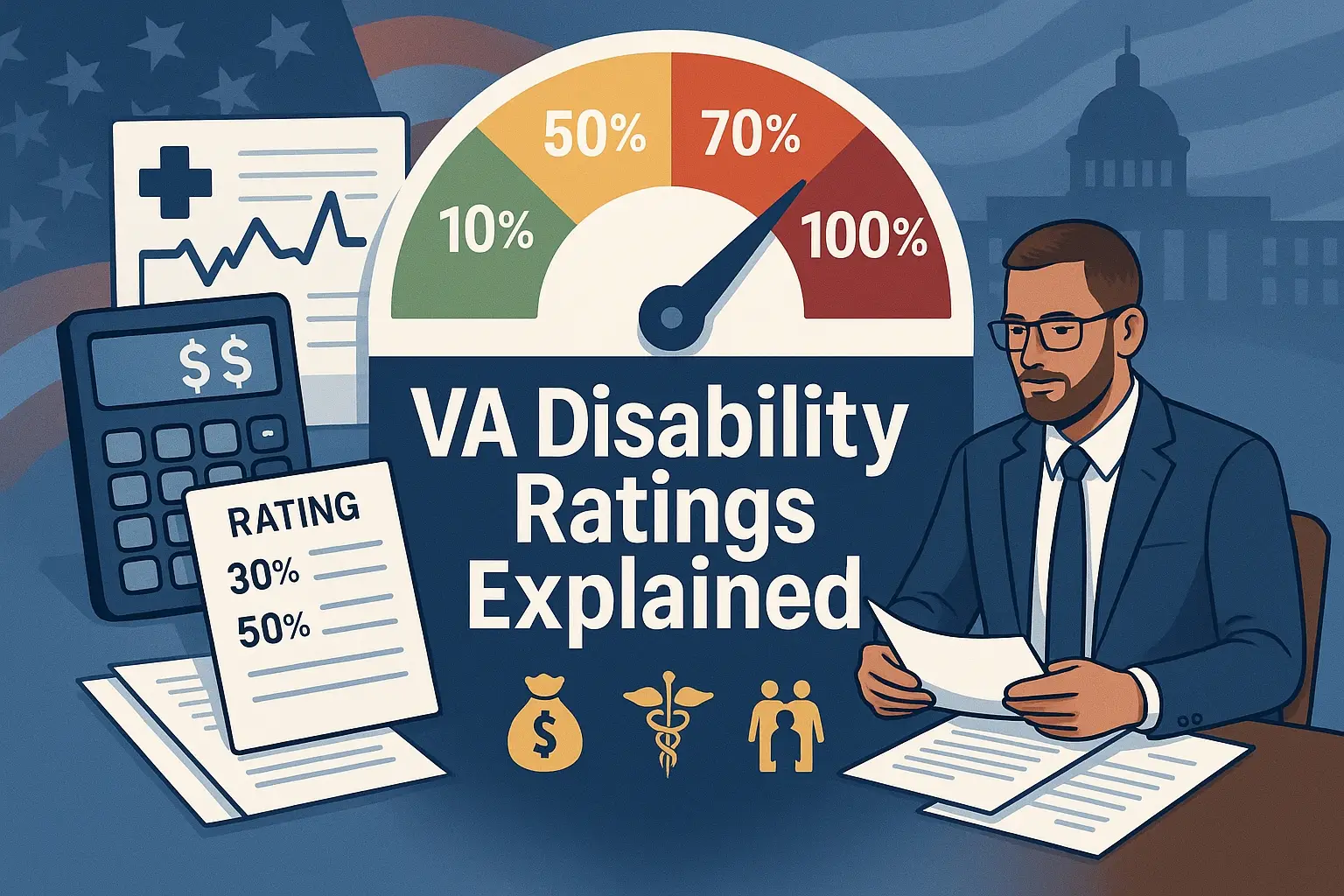
Veterans who sustain injuries, fall ill, or worsen an existing condition while serving in the military are eligible for disability compensation from the Department of Veterans Affairs. These service-connected disabilities are assigned a disability rating that determines a veteran's monthly payment. Ratings also decide eligibility for other benefits, such as health care, training programs, or family assistance.
A disability rating is expressed as a percentage, ranging from 0 percent to 100 percent. The higher the percentage, the more severe the disability and the greater the compensation. A 0 percent rating does not provide a monthly payment. Still, it recognizes that the condition is related to service and may qualify the veteran for medical treatment and certain other benefits.
Understanding the rating system is essential for many veterans and their families. The percentage assigned affects combined disability rating calculations, monthly compensation, and eligibility for benefits that extend to dependents, such as a spouse, children, or dependent parents. It also influences benefits for a surviving spouse or other family members if the veteran dies.
What Are VA Disability Ratings?
A VA disability rating is a percentage assigned by the Department of Veterans Affairs to measure the severity of a service-connected disability. Ratings range from 0 percent to 100 percent in 10 percent increments. This percentage directly determines the amount of monthly compensation a veteran receives, as well as eligibility for additional benefits.
Purpose of Disability Ratings
- Compensation for impairment: Ratings provide financial support to veterans whose ability to earn a living is reduced by a disability caused or aggravated during military service.
- Access to VA benefits: The percentage assigned impacts monthly payment and determines eligibility for health care, training, and other benefits provided by Veterans Affairs.
- Recognition of service impact: A disability rating formally acknowledges that an injury, illness, or existing condition worsened due to active duty and is connected to military service.
How Ratings Work
- Ratings are determined using criteria in the VA Schedule for Rating Disabilities. This system considers the nature of the disability, medical findings, and the effect on a veteran’s ability to work and live.
- A 0 percent rating confirms the condition is related to service but does not qualify for monthly compensation. However, it still makes the veteran eligible for certain benefits, such as health care and priority enrollment.
- Higher percentages reflect greater severity. For example, a veteran with hearing loss may receive a 10 percent rating, while someone diagnosed with PTSD or sleep apnea could receive a much higher percentage based on the condition’s impact.
Examples of Conditions Rated
- Physical conditions: These include musculoskeletal injuries, respiratory disorders, hearing loss, and cardiovascular disease.
- Mental health conditions: These include PTSD, depression, anxiety, and other disorders that affect daily functioning.
- Other conditions: These include chronic illnesses or secondary conditions that develop because of a primary disability.
A disability rating is the foundation of the VA benefits system. It establishes the monthly compensation level and the veteran’s eligibility for other benefits that may extend to dependents, including a spouse, children, or dependent parents.
How the VA Determines a Disability Rating
The Department of Veterans Affairs uses a structured process to assign a disability rating. The goal is to fairly measure how much a service-connected disability limits a veteran’s ability to work and live. To ensure consistency, each case is reviewed using medical records, examinations, and federal regulations.
Key Factors in Rating Decisions
- Severity of symptoms: The VA evaluates how severe the symptoms are and how often they occur. Conditions that interfere more heavily with daily living or the ability to work generally receive higher percentages.
- Medical evidence: Disability ratings are based on medical findings, which include diagnostic test results, treatment records, and Compensation and Pension (C&P) examinations conducted by VA doctors.
- Impact on daily living: The VA examines how the condition affects activities such as employment, education, or caring for family responsibilities.
- Service connection: The veteran must show the disability was caused by military service, aggravated during training, or that an existing condition became worse because of active duty.
Types of Conditions Evaluated
- Physical conditions: These include musculoskeletal injuries, respiratory problems, cardiovascular disease, hearing loss, and sleep apnea.
- Mental health conditions: These include PTSD, depression, anxiety, and other disorders that interfere with social and occupational functioning.
- Other conditions: These include chronic illness, skin disorders, neurological impairments, and secondary issues linked to a primary disability.
Important Notes
- A 0 percent disability rating confirms that the condition is related to military service but does not qualify for monthly compensation. The veteran may still be eligible for medical care and other benefits.
- Ratings may increase if an existing condition gets worse over time. In such cases, the veteran must file a new disability claim or request a review with updated medical evidence.
The VA determines a rating by balancing medical evidence with established regulations. This approach ensures that most veterans with similar conditions receive consistent outcomes while allowing adjustments if a condition worsens or new evidence is provided.
Understanding a Combined Disability Rating
Many veterans have more than one service-connected disability. When this occurs, the Department of Veterans Affairs does not simply add the percentages. Instead, it uses a formula known as the combined ratings table to calculate a combined disability rating. This system ensures that each additional disability is considered in relation to the veteran’s remaining ability to function.
How Combined Ratings Work
- The VA starts with the highest individual rating, which reflects the most severe condition.
- The next rating is applied to the remaining efficiency rather than being added directly.
- This process continues until all disabilities are factored in.
- The result is then rounded to the nearest 10 percent to determine the final combined rating.
Example Calculations
- A veteran with a 30 percent rating for PTSD and a 20 percent rating for a back injury does not receive a 50 percent rating. Instead, the VA applies the second percentage to the remaining 70 percent efficiency, which results in a combined rating of 44 percent. This number is rounded down to 40 percent.
- A veteran with a 50 percent rating for sleep apnea and a 30 percent rating for hearing loss would receive a combined rating of 65 percent, which rounds up to 70 percent.
Combined Ratings Table
The combined ratings table is the tool used to determine these calculations. The Veterans Affairs publishes it and ensures all cases follow the same process. Veterans can use this table to estimate their combined rating, but the VA always makes the official calculation.
Key Points to Remember
- A combined disability rating reflects the overall impact of multiple conditions rather than the sum of each percentage.
- Ratings are rounded to the nearest 10 percent.
- Most veterans find the combined ratings table confusing at first, but understanding it is essential for knowing how monthly compensation is determined.
A combined disability rating directly affects a veteran's monthly payment amount. It also influences eligibility for additional benefits, such as dependent compensation for a spouse, dependent children, or dependent parents.
Monthly Payment and Monthly Compensation for Veterans
A disability rating determines a veteran's monthly compensation from the Department of Veterans Affairs. The higher the percentage, the greater the monthly payment. These payments are adjusted annually based on the cost of living to keep pace with inflation.
Basic Monthly Payment Amounts
The following examples illustrate 2024 rates for veterans without dependents:
- 10 percent disability rating: $171.23 per month
- 20 percent disability rating: $338.49 per month
- 30 percent disability rating: $524.31 per month
- 50 percent disability rating: $1,075.16 per month
- 70 percent disability rating: $1,716.28 per month
- 100 percent disability rating: $3,737.85 per month
These amounts represent the base monthly compensation for a single veteran.
Additional Benefits for Dependents
Veterans with qualifying dependents may receive higher monthly payments. The VA considers the following dependent status categories:
- Spouse: Veterans with a spouse may receive additional monthly compensation.
- Dependent children: Extra compensation may apply for each child, including an additional child over age 18 who is still in school.
- Dependent parents: Veterans supporting one or two parents may qualify for higher rates.
- Surviving spouse: In the event of a veteran’s death, a surviving spouse may receive benefits through Dependency and Indemnity Compensation (DIC).
Other Factors Affecting Monthly Compensation
- Special Monthly Compensation (SMC): This applies to veterans with severe disabilities, such as loss of use of limbs or the need for aid and attendance.
- Total Disability based on Individual Unemployability (TDIU): Veterans unable to maintain employment due to service-connected disabilities may be compensated at the 100 percent level even if their combined rating is lower.
- Combined disability rating: Veterans with more than one disability must use the combined ratings table to determine the final percentage, which then dictates the monthly payment amount.
Monthly compensation provides essential financial support for veterans with disabilities caused or aggravated by military service. These payments also help families, ensuring that dependents and survivors can access the necessary benefits.
VA Benefits for Dependents and Family Members
The Department of Veterans Affairs recognizes that a service-connected disability often affects more than the veteran. To support families, additional VA benefits are available for dependents, including a spouse, dependent children, and dependent parents. These benefits can increase the veteran’s monthly compensation and sometimes provide separate programs for survivors.
Spouse Benefits
When added as a dependent, a spouse may qualify for an increased monthly payment. If the veteran passes away, a surviving spouse may receive Dependency and Indemnity Compensation (DIC), a separate program designed to provide financial support.
Benefits for Dependent Children
- Veterans can receive additional monthly compensation for each dependent child under 18.
- An additional child over 18 may also qualify if still in school full-time.
- Children with disabilities that prevent independent living may continue to receive support beyond the standard age limits.
Benefits for Dependent Parents
Veterans supporting one or two dependent parents may receive higher monthly payment amounts. These benefits recognize the financial responsibility veterans often have for family members who rely on their care.
Survivor Benefits
In addition to DIC for a surviving spouse, children, and, sometimes, parents may qualify for survivor programs. These may include education benefits, health care access, and pension support. Survivor benefits help ensure that family members remain supported even after the veteran's death.
VA benefits for dependents and family members are an important extension of disability compensation. They recognize the role of family in supporting veterans living with disabilities and ensure that dependents have financial and practical assistance.
Disability Compensation and Other Benefits Available
A disability rating primarily determines eligibility for monthly compensation, but veterans may also qualify for other benefits. The Department of Veterans Affairs offers programs that extend beyond direct payments to address medical, educational, and living needs.
Disability Compensation
Disability compensation is the core benefit provided to veterans with a service-connected disability. It is a tax-free monthly payment based on the assigned rating. Compensation is intended to offset the reduced ability to work or maintain a normal standard of living due to conditions caused or made worse by military service.
Pension
Some veterans may qualify for a VA pension. This program is different from disability compensation based on age, income, and wartime service. A pension is designed to provide financial assistance to low-income veterans who meet these criteria.
Aid and Attendance
Veterans with severe disabilities may qualify for Special Monthly Compensation through aid and attendance. This benefit is available when a veteran requires help with daily activities such as bathing, dressing, or eating. It increases the total monthly payment amount beyond the standard schedule.
Health Care and Other Benefits
- Health care access: Veterans with a disability rating may receive priority access to VA medical services.
- Vocational and educational support: Benefits may cover training programs, tuition assistance, or resources for school-age children.
- Housing and living assistance: Special programs provide housing grants or home modifications for veterans with physical conditions that limit mobility.
Disability compensation is the foundation, but other benefits help veterans and their families manage the broader impact of service-connected conditions. From pensions to training and aid programs, these resources reflect the VA’s commitment to supporting those who served.
How to File a Claim for VA Disability Benefits
Filing a disability claim is the first step toward receiving disability compensation from the Department of Veterans Affairs. The process can be completed online, by mail, in person, or with the help of an accredited representative. Veterans should prepare supporting evidence to ensure their claim is reviewed correctly.
Steps to File a Claim
- Complete the application: Veterans must file VA Form 21-526EZ, the primary form for disability benefits. This form is available online through VA.gov or by contacting a regional office.
- Gather medical records: Documentation should include service treatment records, private medical reports, and evidence showing that an existing condition worsened due to active duty.
- Include lay statements: Statements from family, friends, or fellow service members can provide context about how a disability affects daily living and work.
- Submit the claim: Claims can be filed online, mailed to the VA, delivered in person to a VA regional office, or submitted through an accredited Veterans Service Organization.
- Attend required exams: Many claims require a Compensation and Pension (C&P) exam to evaluate the severity of the condition and help determine the appropriate disability rating.
What to Expect After Filing
- Initial review: The VA checks the claim for completeness and begins gathering evidence.
- Evidence gathering: Additional records may be requested, or medical exams may be scheduled.
- Decision: The VA assigns a disability rating and issues a decision letter explaining the outcome.
- Appeal options: If the veteran disagrees, they can file for a higher-level review, submit new evidence, or appeal to the Board of Veterans’ Appeals.
Key Tips
- Veterans should keep copies of all forms and evidence submitted.
- Contacting an accredited representative can help ensure the claim is accurate and complete.
- Many veterans find that professional guidance improves the chance of receiving the correct disability rating and monthly compensation.
Filing a claim may seem complex, but following the proper steps and providing thorough documentation ensures that veterans are better positioned to qualify for the benefits they earned through military service.


