
VA disability compensation is a monthly tax-free payment provided by the Department of Veterans Affairs to veterans with service-connected disabilities. This benefit applies to conditions incurred or aggravated during active duty, inactive duty, or training. It is intended to provide financial support for veterans whose injury, chronic illness, or mental health conditions affect their ability to work or carry out daily activities.
For most veterans, disability compensation recognizes the lasting effects of military service. The program helps ensure that eligible service members and their families can stabilize when health challenges interfere with employment or quality of life. Payments are based on a disability rating, which measures the severity of a condition and its impact on overall functioning.
Both physical conditions, such as back injuries, hearing loss, and lung disease, and mental health conditions, including PTSD, depression, and anxiety, are considered when determining compensation. Veterans with multiple conditions may also receive a combined disability rating. The program ensures that those affected by their service can access appropriate support through fair compensation.
What Are VA Disability Benefits?
VA disability benefits are tax-free payments that provide financial support to veterans with service-connected disabilities. These benefits are administered by the Department of Veterans Affairs and are one of the most widely used programs for supporting former service members. Disability benefits help compensate for income loss, cover the impact of medical conditions, and acknowledge the sacrifices made during military service.
Physical Conditions Covered
Veterans may qualify for disability compensation if they suffer from physical conditions linked to their active or inactive duty time. Examples include:
- Chronic illnesses, such as ulcers, arthritis, or cancer
- Hearing loss or vision impairment caused by military service
- Lung disease, respiratory conditions, or other illnesses related to toxic exposure
- Back injuries, scar tissue, or loss of motion from accidents or training
- An existing condition that became worse because of their service
Each condition is evaluated to determine its severity and impact on the veteran’s daily life.
Mental Health Conditions Covered
Disability benefits also cover mental health conditions that may develop during or after service. These conditions can be as disabling as physical injuries and are evaluated carefully by the VA. Common examples include:
- Posttraumatic stress disorder (PTSD)
- Depression or anxiety
- Mental illness linked to military sexual trauma (MST)
- Traumatic brain injury (TBI) with related psychological symptoms
By including mental health conditions in disability compensation, the VA ensures that veterans receive fair recognition and support for the full scope of challenges they may face.
Support for Survivors
In addition to direct payments to veterans, benefits may also extend to survivors. A surviving spouse, dependent children, or dependent parents may qualify for dependency and indemnity compensation if the veteran died from a service-connected disability. This program helps ensure that families continue to receive support even after the loss of a loved one.
VA Disability Compensation Rates (2024–2025)
VA disability compensation is calculated based on a veteran’s disability rating, which is expressed in 10 percent increments from 0 to 100 percent. The Department of Veterans Affairs assigns this rating according to the severity of a service-connected disability and its impact on the veteran’s ability to function. The higher the rating, the greater the amount of monthly compensation provided.
Basic Monthly Compensation Rates (Veteran Only)
The following list outlines the monthly compensation rates for veterans without dependents in 2024–2025:
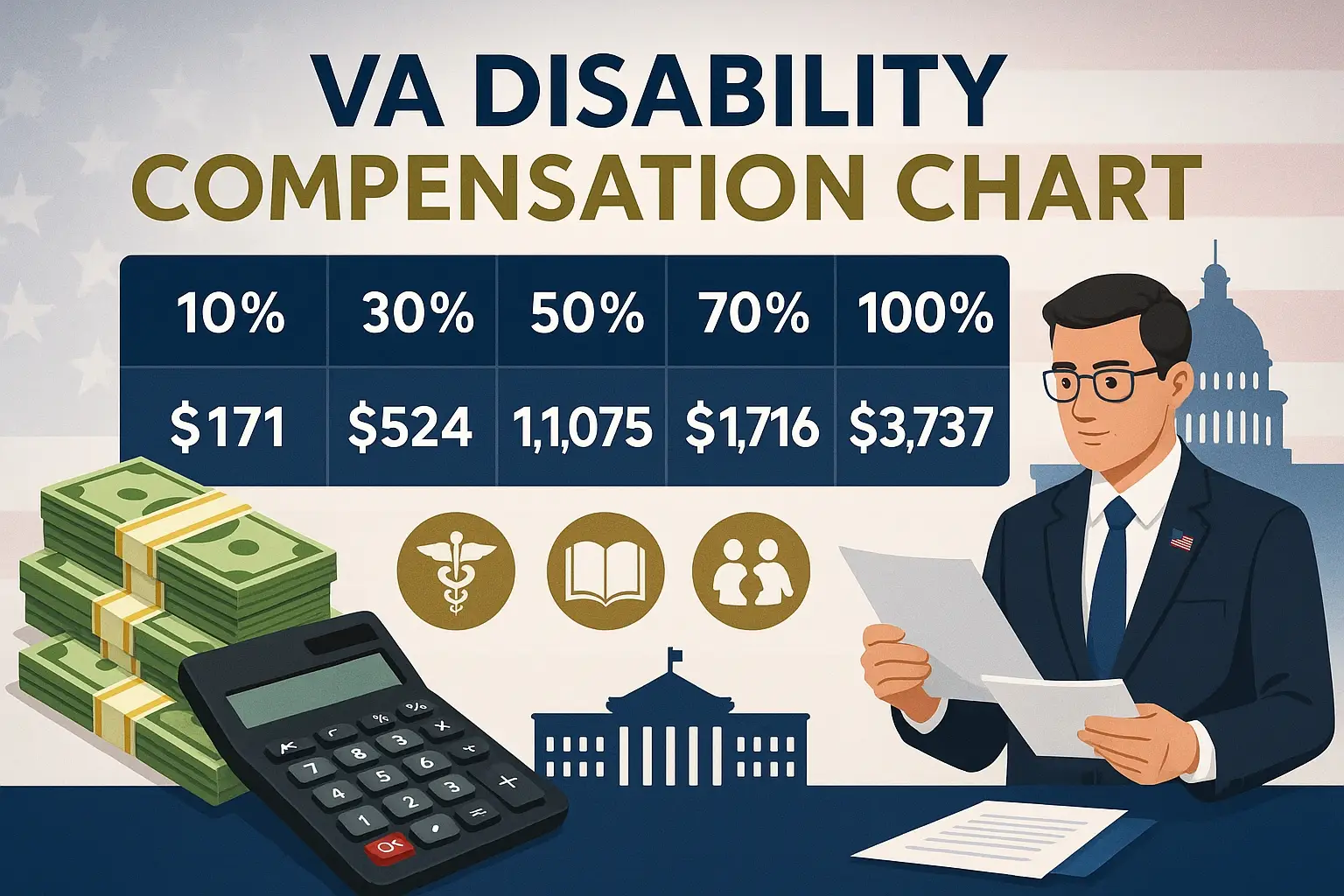
- A 10 percent rating provides $171.23 each month.
- A 20 percent rating provides $338.49 each month.
- A 30 percent rating provides $524.31 each month.
- A 40 percent rating provides $755.28 each month.
- A 50 percent rating provides $1,075.16 each month.
- A 60 percent rating provides $1,361.88 each month.
- A 70 percent rating provides $1,716.28 each month.
- An 80 percent rating provides $1,995.01 each month.
- A 90 percent rating provides $2,241.91 each month.
- A 100 percent rating provides $3,737.85 each month.
These figures apply only to veterans. Most veterans see their compensation increase as their rating rises since higher percentages reflect more severe disabilities.
Compensation with Dependents
Veterans with a disability rating of 30 percent or higher may receive additional monthly compensation if they have dependents, including a spouse, dependent children, or dependent parents.
- A spouse adds between $57.00 at a 30 percent rating and $190.41 at a 100 percent rating.
- Each child adds between $28.50 at a 30 percent rating and $95.22 at a 100 percent rating.
- A dependent parent adds between $76.00 at a 30 percent rating and $253.55 at a 100 percent rating.
These increases help ensure that the needs of family members are considered when determining the total benefit amount.
Cost-of-Living Adjustments
The VA applies cost-of-living adjustments, also known as COLA, each year. These adjustments are linked to Social Security benefits and are intended to protect veterans from the effects of inflation. As a result, monthly compensation generally increases slightly from year to year.
Eligibility for VA Disability Benefits
Not all veterans automatically qualify for VA disability benefits. The Department of Veterans Affairs has established clear eligibility rules to ensure that compensation is provided only when a disability is directly linked to military service. Veterans must meet both general requirements and condition-specific criteria.
Basic Eligibility Requirements
To be eligible for disability benefits, both of the following must be true:
- The veteran must have a current physical or mental condition that affects their health or daily functioning.
- The veteran must have served on active duty, active duty for training, or inactive duty training.
Service Connection Categories
A veteran must also demonstrate that their condition is connected to military service in one of the following ways:
- The veteran became sick or injured while serving, and the condition continues to affect them. This is known as an in-service disability claim.
- The veteran had a condition before joining the military, but active duty worsened the condition. This is known as a pre-service disability claim.
- The veteran developed a disability after leaving the military, but it is directly related to their service. This is known as a post-service disability claim.
Presumptive Conditions
In some cases, the VA presumes that certain illnesses or injuries are related to military service. Veterans do not have to prove the connection, but they must meet service requirements. These presumptive conditions include:
- A chronic illness that appears within one year after discharge
- An illness caused by exposure to toxic chemicals, hazardous materials, or burn pits
- A condition resulting from time spent as a prisoner of war
Who May Qualify
- Service members with verified service-connected disabilities
- Veterans whose condition worsened because of military service
- Survivors, including a surviving spouse, dependent children, or dependent parents (in cases of death linked to a service-connected disability)
How to File a VA Disability Claim
The claims process is the official method for veterans to request VA disability compensation. Filing a claim requires providing details about the disability, submitting supporting documentation, and following the steps outlined by the Department of Veterans Affairs. Veterans can choose from several filing options depending on their preference and circumstances.
Filing Methods
Veterans may file a disability claim using one of the following methods:
- A veteran can file a claim online through the official VA website, which is generally the fastest method and allows tracking of the claim status.
- A veteran can file a claim by mail using VA Form 21-526EZ, which must be sent to the VA’s Claims Intake Center.
- A veteran can submit an application by visiting a VA regional office, where staff can assist directly.
- A veteran can file a claim by fax, with a separate international number available for those outside the United States.
- A veteran can work with an accredited attorney, claims agent, or Veterans Service Organization representative who can help prepare and submit the claim.
Required Documents and Evidence
Supporting documentation is an integral part of every disability claim. Veterans should gather the following types of evidence before filing:
- Medical records from the VA that document the current physical or mental condition
- Private medical records that show treatment for the claimed condition or demonstrate that the disability has become worse
- Supporting statements from family members, a spouse, a parent, or fellow service members that provide additional evidence of the disability’s impact
If the VA requests more evidence, the veteran must provide additional information or new evidence before a decision is made.
Intent to File
Veterans who plan to file a claim but need time to collect evidence can submit an intent to file form. This step notifies the VA of the veteran’s intention and secures an earlier effective date for benefits. If the veteran files the whole claim within the required timeframe, they may receive retroactive payments based on the intent to file date.
Submitting an intent to file is unnecessary when completing the claim online, as the system automatically records the start date once the application is initiated.
Understanding Disability Ratings and the Combined Ratings Table
The VA uses a disability rating system to measure the severity of a veteran’s service-connected disability. Ratings are assigned in 10 percent increments, ranging from 0 to 100 percent. The rating determines the level of monthly compensation and reflects how much the condition affects a veteran’s ability to work and perform daily activities.
How Ratings Are Determined
Disability ratings are based on medical evidence, service records, and claim examination results. The Department of Veterans Affairs considers physical and mental health conditions when assigning a percentage.
- A higher percentage means the condition is more severe and has a greater impact on daily functioning.
- A lower percentage means the condition is less severe and may not significantly limit the veteran’s ability to work.
- Most veterans receive ratings between 10 and 60 percent, while severe cases may be rated 100 percent.
Combined Disability Rating
When a veteran has more than one service-connected disability, the VA does not simply add the percentages. Instead, the VA uses a combined ratings table.
- A combined disability rating accounts for the overall effect of multiple conditions on the veteran’s health and ability to function.
- The VA considers each disability in order of severity, starting with the highest rating, and applies the next rating to the remaining percentage of ability.
- This calculation often results in a combined rating lower than the sum of the individual percentages.
Claim Examinations
The VA may require a claim exam—called a Compensation and Pension (C&P) exam—to gather more evidence about the disability.
- During this exam, a VA healthcare provider or contracted provider evaluates the condition and its severity.
- The exam helps determine whether the disability is service-connected and whether the current rating is accurate.
- If the VA requires more evidence after the exam, the veteran will receive a VA notification letter with instructions on what to provide.
Special Circumstances, Dependents, and Other Benefits
VA disability compensation may increase when certain special circumstances apply. These adjustments are designed to recognize that some disabilities create greater challenges and dependents may rely on this financial support. Veterans and their families should understand the additional payments and programs available in these situations.
Special Monthly Compensation
Some veterans qualify for Special Monthly Compensation, also known as SMC. This payment is provided in addition to standard disability compensation and is reserved for individuals with severe disabilities. For example, it may apply when a veteran has lost the use of a limb, an organ, or sight in one or both eyes. It may also apply if a veteran requires aid and attendance because of limited independence or if they are housebound due to their condition. The purpose of SMC is to acknowledge and address the extra financial and personal challenges caused by serious service-connected disabilities.
Dependents and Family Support
Disability benefits may also increase when a veteran has dependents. A spouse may qualify for additional monthly compensation when the veteran’s disability rating is 30 percent or higher. Dependent children are also eligible for increased payments, and in some cases, support continues if the child is pursuing education or cannot live independently because of a disability.
A dependent parent may also qualify if they rely on the veteran for financial support. These increases recognize that disabilities affect not only the veteran but also the people who depend on them.
Other VA Benefits
In addition to monthly compensation, the Department of Veterans Affairs provides other benefits designed to promote long-term stability. Education and training programs can help veterans prepare for civilian employment or advance in their careers. Healthcare programs are available to ensure that veterans can receive treatment for chronic illness, injury, or mental illness linked to service.
Survivors, including a surviving spouse or dependent children, may also qualify for dependency and indemnity compensation if the veteran’s death was connected to a service-related disability. These programs expand the support available to veterans and their families beyond monthly compensation payments.
Veterans Disability Benefits vs. Social Security Benefits
Veterans' disability and Social Security benefits are separate programs that sometimes overlap. Understanding their differences helps veterans decide whether they qualify for one or both and how each program provides support.
VA Disability Compensation vs. VA Pension
- Basis of eligibility: VA disability compensation is based on a service-connected disability that was incurred or made worse during active duty or inactive duty service, while a VA pension is based on financial need.
- Income requirements: VA disability compensation is not tied to income or assets, whereas a VA pension is available only to wartime veterans who meet income and asset limits.
- Tax status: VA disability compensation is always tax-free, while VA pension payments are also tax-free but generally lower in amount.
- Exclusivity: A veteran cannot receive both compensation and pension simultaneously, and disability compensation usually provides higher payments for those with qualifying conditions.
VA Disability Compensation vs. Social Security Disability
- Eligibility criteria: VA disability compensation requires proof that a disability is connected to military service, while Social Security Disability Insurance requires proof that the condition prevents the person from working and that they have sufficient work history.
- Administration: VA disability compensation is managed by the Department of Veterans Affairs, while Social Security benefits are managed by the Social Security Administration.
- Concurrent benefits: Veterans can receive both VA disability compensation and Social Security Disability Insurance at the same time if they meet the requirements for each program.
- Independence of programs: Approval for VA disability does not guarantee approval for Social Security benefits because each program has separate rules.
Additional Programs and Support
- Vocational Rehabilitation and Employment (VR&E): This VA program helps veterans with service-connected disabilities rated at 20 percent or higher by providing education, training, and job placement assistance.
- Long-term focus: VR&E supports reintegration into the civilian workforce and independence, while Social Security benefits primarily provide income replacement when work is not possible.
VA Disability Decision Review and Appeals Process
After a veteran files a disability claim, the Department of Veterans Affairs issues a decision. If the veteran disagrees with the outcome, they have the right to request a decision review. The appeals process provides multiple options for submitting more evidence, requesting a higher-level review, or appealing to the Board of Veterans’ Appeals.
Receiving the VA Notification Letter
- Official decision: The VA sends a notification letter that explains the outcome of the disability claim and provides the assigned disability rating.
- Review opportunity: The letter also outlines the veteran’s right to request a decision review if they disagree with the findings.
Options for Decision Review
- Supplemental claim: A veteran may file a supplemental claim if they have new evidence that was not considered during the original review.
- Higher-level review: A veteran may request a higher-level review by a senior claims adjudicator who re-examines the case without introducing new evidence.
- Board appeal: A veteran may appeal to the Board of Veterans’ Appeals, which allows a judge to review the claim and make a final decision.
Gathering and Submitting More Evidence
- Medical documentation: Veterans may provide additional medical records to show that a condition is more severe than originally determined.
- Personal statements: Veterans, spouses, or family members may submit statements describing how the disability affects daily life.
- Service records: Veterans may submit new service documents that confirm an injury or illness was connected to military service.
Timelines and Expectations
- Decision deadlines: Veterans must file a decision review request within the time frame outlined in the VA notification letter, usually one year from the decision date.
- Processing time: The time required for review varies depending on the option chosen, with higher-level reviews generally processed faster than Board appeals.
- Outcome: A review may result in an increased disability rating, no change, or, in some cases, a reduced rating if the evidence does not support the claim.
Official VA Resources and Support Programs
The Department of Veterans Affairs provides a wide range of resources to help veterans, dependents, and survivors navigate the claims process and access disability benefits. Using official sources ensures that veterans receive accurate information and avoid relying on unofficial or outdated guidance.
VA Contact Information
- VA Benefits Hotline: Veterans can call 1-800-827-1000 to ask questions about disability claims, compensation rates, and eligibility.
- General information line: Veterans can call 1-844-698-2311 for assistance with broader VA services and resources.
- TDD for hearing impaired: Veterans can use 1-800-829-4833 to communicate with the VA through a telecommunications device for the deaf.
Accredited Representatives
- Veterans Service Organizations (VSOs): VSOs provide free assistance from trained representatives who can help prepare and file disability claims.
- Accredited attorneys and claims agents: Veterans can also choose to work with attorneys or agents accredited by the VA to ensure compliance and effective representation.
- In-person assistance: Veterans may visit a local VA regional office for direct support with claims, decision reviews, or appeals.
Online Tools and Applications
- VA.gov: The official VA website provides access to disability compensation charts, claim forms, and eligibility information.
- Benefits portal: This secure online platform allows veterans to manage benefits, track claims, and update personal information.
- VA mobile app: Veterans can use the mobile application to access resources and check the status of their claims conveniently.
Educational and Support Resources
- Compensation 101 videos: The VA’s official YouTube channel provides educational videos that explain how disability compensation works.
- Claim exam guidance: Veterans can review official resources to learn what to expect during a Compensation and Pension exam.
- Evidence requirements: The VA publishes detailed guidance on what types of documents and medical records can strengthen a claim.


