Social Security Disability Insurance (SSDI) provides vital income support to Pennsylvanians who are unable to work due to a serious medical condition. It replaces lost wages for individuals whose disabilities prevent them from maintaining steady employment. SSDI is funded through payroll taxes, enabling eligible workers to access earned benefits during times of hardship. In Pennsylvania, it acts as a critical safety net for thousands of disabled residents.
Disability benefits ensure that individuals facing long-term health limitations can sustain their basic living needs and maintain financial stability. Understanding the application process helps applicants avoid delays and increase their chances of approval. Many denials result from missing documents or incomplete information. Knowing what to prepare empowers Pennsylvanians to navigate the system confidently.
This guide provides clear steps to qualify for SSDI, complete applications, and successfully manage appeals. It also explains where to find legal support and local Social Security offices in Pennsylvania. Each section is written for beginners needing straightforward guidance through a complex process. By following this roadmap, applicants can improve their chances of timely approval and lasting financial relief.
Medical Conditions That May Qualify for Disability Benefits
Many medical conditions meet the Social Security Disability Insurance (SSDI) standards set by the Social Security Administration (SSA). Understanding which disabilities qualify helps Pennsylvanians determine eligibility before starting the application process for SSDI benefits. Below are key groups of qualifying impairments recognized in Social Security Disability evaluations. Each one requires documented medical evidence and proof that the condition significantly limits daily functioning or work ability.
- Musculoskeletal Disorders: These include back injuries, arthritis, fractures, and spinal disorders that make physical work extremely difficult or impossible. The disability determination services review medical records to confirm how these conditions affect your ability to perform past work. A qualifying disability in this category often requires proof that movement or endurance is significantly limited. If supported by strong documentation, you can receive SSDI benefits faster.
- Neurological Conditions: Serious conditions like cerebral palsy, epilepsy, Parkinson’s disease, and amyotrophic lateral sclerosis (ALS) may qualify under SSA’s definition of disability. These disorders can prevent a person with a disability from performing any substantial gainful activity (SGA). Detailed medical records and consistent treatment notes strengthen the disability determination. The SSA often expedites claims involving permanent disabilities or rapidly worsening neurological conditions.
- Mental Health Disorders: Depression, bipolar disorder, post-traumatic stress disorder, and schizophrenia can qualify for social security disability benefits if symptoms significantly limit concentration, social interaction, or reliability at work. The SSA may request medical evidence from therapists or psychiatrists to verify ongoing treatment. Applicants must demonstrate how their disability began and how it prevents them from consistently earning a living income. Accurate reports from licensed professionals help determine eligibility for both SSI and SSDI benefits.
- Cardiovascular and Respiratory Diseases: Conditions like heart disease, chronic obstructive pulmonary disease (COPD), and asthma may qualify if they restrict breathing or stamina. These illnesses often require continuous medical monitoring, hospitalization records, and proof of limited capacity for substantial gainful activity. The SSA reviews test results and doctor evaluations to confirm the severity of disability. A clear link between the medical condition and work limitations helps applicants receive disability benefits smoothly.
- Unlisted or Complex Conditions: Even conditions not explicitly listed in the SSA’s Blue Book may qualify if they cause similar or greater functional restrictions. Applicants must demonstrate through medical records and physician statements that their impairment is equal to or greater in severity than a listed condition. Those with multiple combined conditions may also qualify if overall functioning is significantly limited. Consulting a Pennsylvania disability lawyer or visiting a local SSA office can clarify next steps.
Applicants should remember that strong medical evidence, consistent treatment, and detailed work history are essential for approval. Understanding how Social Security defines a qualifying disability helps individuals present a complete initial application and avoid unnecessary delays. By thoroughly documenting symptoms and cooperating with disability determination services, Pennsylvanians can increase their chances of receiving fair and timely SSDI benefits.
How to Apply for SSDI in Pennsylvania (Application Process)
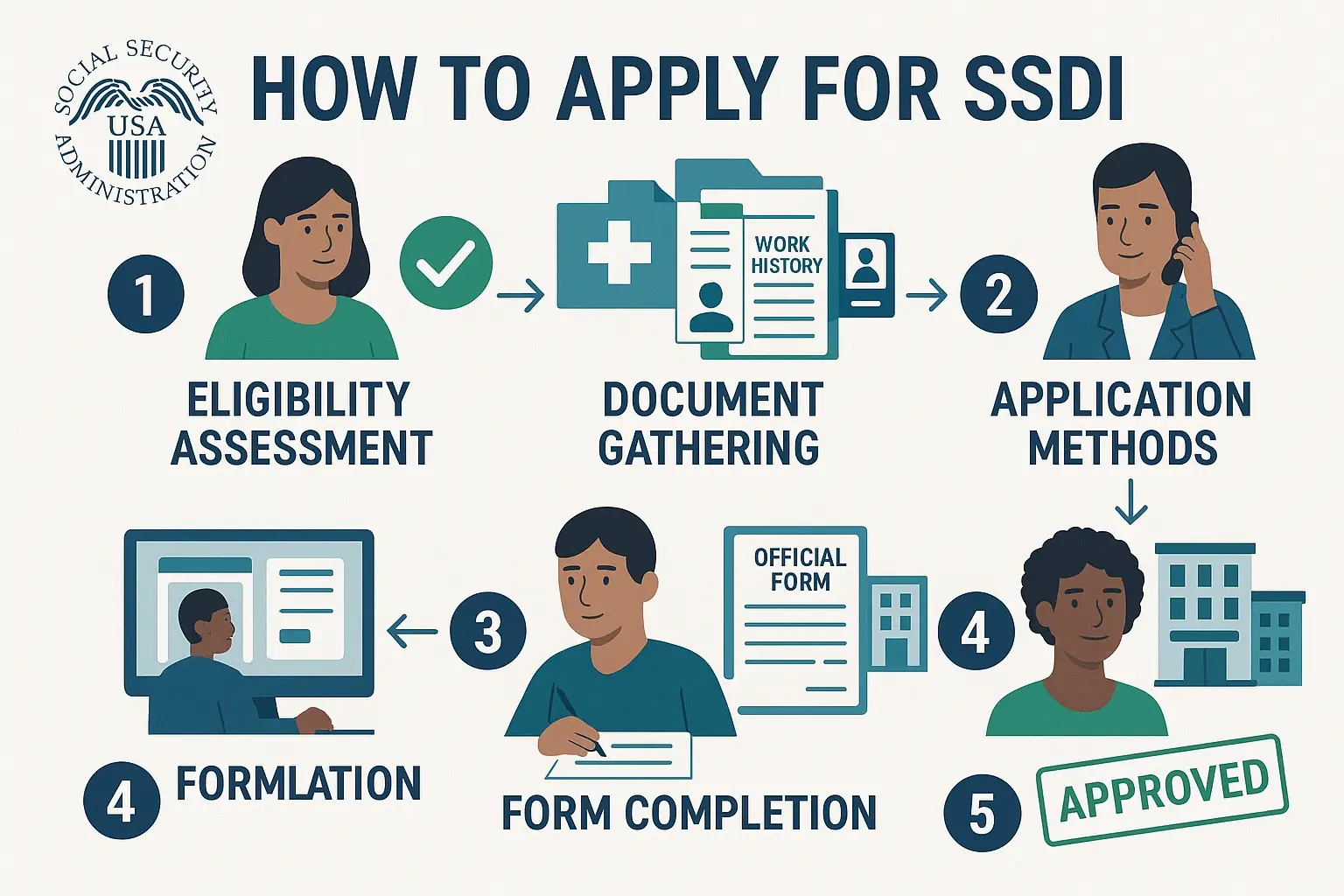
Applying for Social Security Disability Insurance (SSDI) in Pennsylvania requires organization, accurate documentation, and a thorough understanding of the Social Security Administration's (SSA) procedures. Each step plays a critical role in ensuring your claim is reviewed efficiently. Below are essential methods and best practices for completing the application process and securing SSDI benefits.
Apply Online Through the SSA Website
Applicants can apply for disability benefits directly at ssa.gov through the SSA’s secure online portal. This method enables individuals to start, pause, and complete their application online without needing to visit a local Social Security office. Online filing is ideal for people who already have the necessary information and medical records prepared. This process reduces delays and provides immediate confirmation that your initial application has been submitted.
Prepare Required Information and Records
Before you start, gather all essential documents to prevent incomplete submissions. You’ll need to provide personal details, including your Social Security number, marital status, and a work history that shows paid Social Security taxes. Collect comprehensive medical evidence, such as test results, physician notes, and hospital records, verifying your qualifying disability. Including detailed information about your disability start date helps determine eligibility more quickly.
Alternative Application Options
If you prefer not to apply online, you may apply for disability benefits by phone or in person. Call the SSA’s toll-free number at 1-800-772-1213 to schedule an appointment or request guidance. Individuals with hearing impairments can contact TTY 1-800-325-0778 for assistance. In-person applications can be completed at a local SSA office, but appointments are required to avoid long wait times.
Best Practices for Organizing Documentation
Keep all medical evidence, work credits, and contact information for healthcare providers in a dedicated folder. Organize your medical records chronologically to help the SSA’s disability determination services evaluate your claim efficiently. Ensure your work history includes all employers and dates to verify the Social Security taxes you have paid. Organized documentation increases your chances of approval during the disability determination stage.
Tips to Avoid Delays in Processing
Submit accurate and consistent information in every section of your SSDI in Pennsylvania application. Double-check all forms for missing fields, outdated addresses, or incomplete descriptions of medical conditions. Respond promptly to any SSA correspondence requesting updates or clarification. Staying proactive during the review process helps applicants receive SSDI benefits more efficiently, avoiding unnecessary delays.
Successfully navigating the Social Security Disability application process in Pennsylvania requires thorough preparation and attention to detail. By gathering strong medical evidence, maintaining accurate work history, and following official SSA procedures, applicants can increase their likelihood of approval. A well-prepared claim ensures faster review and helps individuals access the disability benefits they’ve earned through years of contribution.
Pennsylvania Social Security Offices and Disability Determination Services
Understanding how Social Security offices and Disability Determination Services (DDS) operate in Pennsylvania helps applicants track their claims more effectively. Each office and department has a defined role in verifying eligibility and managing Social Security Disability Insurance (SSDI) applications. The following points outline the steps for locating offices, contacting the relevant agencies, and understanding how disability evaluations are processed in the state.
- Locating Local Social Security Offices: Applicants can find the nearest local Social Security office in Pennsylvania using the SSA’s online Office Locator at ssa.gov/locator. The locator requires a ZIP code to identify the closest branch offering disability benefits and claims assistance. This tool provides office hours, directions, and contact numbers for scheduling appointments. Visiting the right office ensures faster help with your application process or appeal inquiries.
- Understanding Disability Determination Services (DDS): The Office of Disability Determination (ODD) in Pennsylvania partners with the Social Security Administration (SSA) to evaluate medical eligibility for SSDI benefits and Supplemental Security Income (SSI). DDS examiners review medical records, work history, and evidence submitted by applicants to assess whether a person meets the SSA’s definition of disability. Their decisions rely on documented medical proof showing how a condition significantly limits the applicant’s ability to work. This evaluation serves as the foundation for determining whether to approve or deny disability claims.
- State Contact Information and Role in Medical Review: Applicants can contact the Pennsylvania Disability Determination Services by phone at 1-888-772-1409 during business hours, Monday through Friday. DDS offices handle inquiries about pending claims and requests for updates on the review of medical evidence. The agency may contact healthcare providers for additional documentation or to clarify medical details that impact the disability determination. Maintaining communication with DDS helps applicants ensure that their medical condition is properly documented and evaluated.
- Philadelphia Regional Oversight: All Pennsylvania disability claims fall under the jurisdiction of the Philadelphia Regional Office of the Social Security Administration. This regional branch manages coordination among local offices, disability hearing schedules, and appeals processing involving administrative law judges. It ensures consistent decision-making standards across the state and handles complex cases that move beyond the initial application stage. Understanding this hierarchy helps applicants know where their claim is processed during each review phase.
The combined efforts of local SSA offices, state DDS examiners, and the Philadelphia Regional Office ensure fair evaluation and accurate disability determinations for Pennsylvanians. By utilizing official tools, maintaining accurate documentation, and staying in touch with the relevant departments, applicants can enhance communication and expedite the review of their Social Security Disability claims.
Legal Representation and Disability Lawyers for SSDI Benefits
Legal representation plays a crucial role in ensuring fair evaluation for applicants seeking Social Security Disability Insurance (SSDI) in Pennsylvania. Many individuals with disabilities rely on experienced attorneys to manage complex forms, medical evidence, and appeals. Understanding the role of a Pennsylvania disability lawyer can significantly impact the outcome of SSDI benefits, potentially leading to approval rather than denial.
Right to Representation
Every applicant under the Social Security Administration (SSA) has the right to choose legal or non-legal representation during their claim. A qualified lawyer can explain your rights under the federal program and ensure that your case meets eligibility criteria. Representation helps applicants navigate the application process, avoid procedural mistakes, and strengthen their disability claims. Having support throughout this process ensures that each individual with a disability receives fair treatment and due process of law.
Role of Attorneys During Hearings and Appeals
Attorneys prepare and present cases during disability hearings or appeals council reviews. They gather medical evidence, coordinate with doctors, and prepare statements to highlight how a medical condition meets SSA’s definition of disability. During hearings, they communicate directly with the administrative law judge (ALJ) to clarify facts and present strong arguments. Legal guidance increases the chances of a favorable decision, especially after an initial denial.
Administrative Law Judge Oversight
An administrative law judge reviews denied claims independently, evaluating both old and new evidence. The judge ensures that Social Security Disability decisions comply with federal regulations and that the disability determination is fair. Applicants and attorneys can submit additional medical records or witness statements during the hearing. This step is often the most critical phase in reversing an earlier denial and gaining approval for receiving benefits.
Attorney Fee Structure
The Social Security Administration SSA strictly regulates attorney fees to protect applicants. Lawyers typically receive 25% of any back pay awarded, with a maximum fee capped by law. Applicants do not pay upfront; fees are deducted only after benefit payments are approved. This system ensures access to representation for people with limited income or ongoing financial hardship.
Finding SSDI Lawyers in Pennsylvania
Applicants can locate a Pennsylvania disability lawyer through local bar associations, nonprofit legal aid, or referrals from a local Social Security office. Many lawyers specialize in Social Security Disability benefits, SSI benefits, and other disability programs. Free consultations are often available for applicants who need case evaluations or guidance on disability determination services. Choosing the right lawyer ensures your case is well-documented, timely filed, and adequately represented.
Having knowledgeable legal support can make the Social Security Disability Insurance (SSDI) process less overwhelming and far more effective. With an attorney’s help, applicants can meet federal requirements, manage appeals, and protect their right to receive SSDI benefits they have earned through years of Social Security taxes.
SSDI Payment Information and Disability Benefits
Understanding how Social Security Disability Insurance (SSDI) payments work is essential for anyone preparing to apply or already receiving benefits. Each payment reflects a worker’s lifetime earnings and contribution history to the Social Security Administration (SSA). The following points explain how benefit amounts are calculated, when payments start, and how recipients manage their funds effectively.
- Calculation of Monthly SSDI Benefits: The SSA calculates monthly payments based on a worker’s average indexed monthly earnings (AIME) and primary insurance amount (PIA). This formula takes into account the total amount of Social Security taxes an individual has paid throughout their working years. Individuals with a more extended work history and steady earnings typically receive larger SSDI benefits. The SSA’s benefit payments are designed to replace part of the income lost due to a qualifying disability.
- Five-Month Waiting Period Before Payments Start: After approval, recipients typically face a five-month waiting period before their disability benefits begin. This rule ensures that SSDI only covers long-term or permanent disabilities, not short-term conditions. The waiting period starts from the month the disability began, not the date the claim was filed. Applicants should plan for this gap by managing savings or seeking short-term disability insurance if available.
- Medicare Coverage for Long-Term Beneficiaries: Individuals who receive SSDI benefits for 24 consecutive months automatically become eligible for Medicare. This coverage includes Part A (hospital insurance) and Part B (medical insurance), ensuring ongoing medical support for individuals with disabilities. People with amyotrophic lateral sclerosis (ALS) or end-stage renal disease (ESRD) qualify for immediate coverage without waiting. Long-term beneficiaries gain both financial and healthcare security under this federal program.
- Using SSA Calculators and Estimators: Applicants can estimate their SSDI benefits using the SSA’s online calculators at ssa.gov/benefits/calculators. These tools provide projections based on work credits, lifetime earnings, and current contribution levels. Users can also create a “my Social Security” account to view personal earnings records. Accessing these resources helps applicants determine eligibility and plan financially before and after approval.
- Payment Methods and Scheduling Options: The Social Security Administration issues benefit payments monthly, typically through direct deposit or the Direct Express debit card program. Payment dates are determined by the beneficiary’s birth date, ensuring a predictable schedule. Direct deposit offers secure and faster access to funds, eliminating delays and the need for lost checks. Applicants should verify account details with the local SSA office to ensure accurate and timely deposits.
Receiving SSDI in Pennsylvania provides financial stability for workers unable to maintain employment due to severe medical conditions. By understanding payment calculations, waiting periods, and Medicare eligibility, applicants can make informed financial decisions. Staying informed about SSA timelines and payment options ensures that every person with a disability receives their earned Social Security Disability benefits uninterrupted.
The SSDI Appeals Process in Pennsylvania
Filing an appeal for Social Security Disability Insurance (SSDI) in Pennsylvania can feel overwhelming, but understanding the stages helps applicants prepare strategically. Each step of the process gives denied claimants another opportunity to prove their eligibility for disability benefits. Below are the essential stages, time limits, and success strategies that guide applicants through appeals with the Social Security Administration (SSA).
Appeal Stages Overview
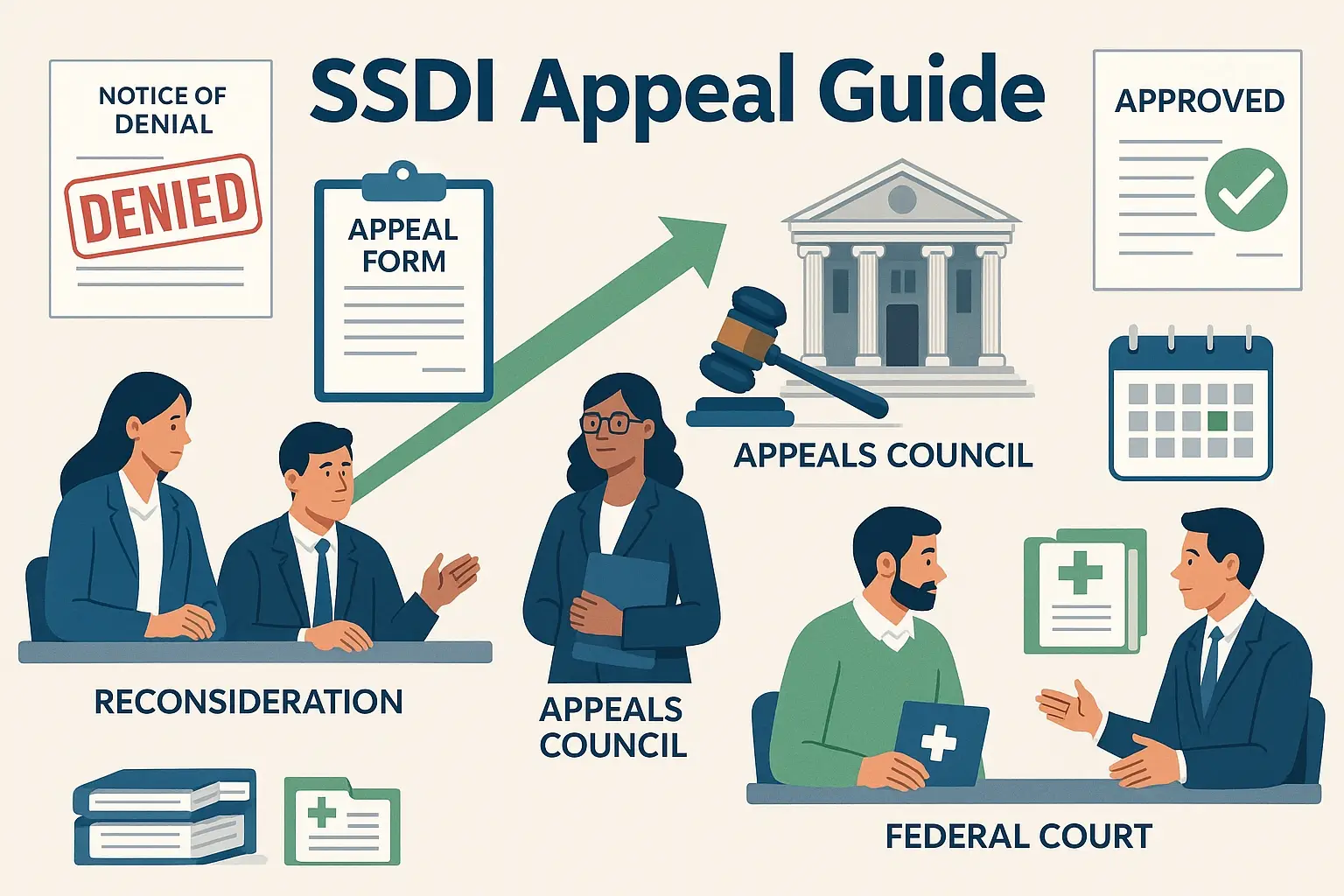
The SSDI appeals process includes four primary levels: reconsideration, disability hearing, administrative law judge (ALJ) review, Appeals Council, and federal court. During reconsideration, a new examiner reviews your case and any new medical evidence. If denied again, applicants may request a hearing before an ALJ who independently reviews all records. Further appeals may go to the Appeals Council, and if necessary, a final challenge can be filed in federal court.
60-Day Appeal Deadline
Applicants have 60 days from the date they receive their denial notice to file an appeal. Missing this deadline could result in having to restart the entire application process. Submitting your appeal early ensures your case stays active and avoids unnecessary delays. The SSA counts the clock from the date on the decision letter, not the day it is opened.
Steps to Strengthen Appeals
Applicants can improve their chances by submitting updated medical records and documenting all treatment progress. Regularly visiting doctors, following medical advice, and maintaining a consistent treatment plan demonstrate credibility. Providing statements from physicians, employers, or caregivers showing how your condition significantly limits work ability adds weight to the claim. Working with a Pennsylvania disability lawyer can help organize this evidence effectively before the disability hearing.
Compassionate Allowances Program
The Compassionate Allowances program fast-tracks cases involving severe or terminal conditions such as amyotrophic lateral sclerosis (ALS) or aggressive cancers. The SSA automatically identifies qualifying cases using specific diagnostic codes. This program enables applicants to receive SSDI benefits more quickly, without having to wait through the full appeal timeline. Pennsylvanians facing critical health situations benefit significantly from this expedited process.
Why Many Appeals Succeed
Many initially denied claims are later approved during the appeal process, especially at the administrative law judge stage. Thorough preparation, accurate medical evidence, and legal representation significantly improve approval rates. Persistence is essential, as the SSA often requires additional documentation to verify a disability determination. Applicants who stay engaged and follow every appeal level carefully usually secure the SSDI benefits they are entitled to.
The appeals process in Pennsylvania rewards applicants who stay organized, meet deadlines, and provide strong evidence. By understanding each stage, following medical guidance, and submitting complete and accurate documentation, applicants can increase their chances of approval. With persistence and support, many Pennsylvanians ultimately win their Social Security Disability cases and achieve financial stability.
Pennsylvania State Disability Resources and Support Programs
Pennsylvania offers several programs designed to help individuals with disabilities access healthcare, employment opportunities, and support for independent living. These resources complement Social Security Disability Insurance (SSDI) and Supplemental Security Income (SSI) by addressing broader needs such as rehabilitation, daily living assistance, and community integration. Understanding these programs helps applicants identify the most suitable services for their specific medical condition or financial situation.
- Office of Vocational Rehabilitation (OVR): The Office of Vocational Rehabilitation (OVR) assists Pennsylvanians with disabilities in preparing for, obtaining, and maintaining employment. It provides services such as job counseling, skills training, career assessments, and assistive technology. OVR works closely with employers to match qualified candidates with appropriate roles based on their functional abilities. Applicants can contact their nearest OVR district office to schedule an intake interview and discuss individualized employment plans.
- Home and Community-Based Services (HCBS): The Home and Community-Based Services (HCBS) program supports individuals who prefer to receive care in their homes rather than in institutional settings. It offers personal care assistance, transportation, home modifications, and caregiver support. Eligibility is determined through assessments that evaluate a person’s medical and functional needs. HCBS helps participants maintain independence while receiving essential care in their communities.
- PA Link to Aging and Disability Resources: The PA Link to Aging and Disability Resources acts as a statewide network connecting Pennsylvanians to long-term care options and public benefit programs. It offers free guidance on housing, healthcare, and financial support to individuals with limited income. The service streamlines access to multiple agencies through a single point of contact, saving time and reducing confusion for applicants. Local PA Link partners work closely with county offices to provide personalized assistance.
- Intellectual and Developmental Disability Services: The Intellectual and Developmental Disability (IDD) Services program supports individuals with autism, Down syndrome, and related developmental conditions. These services are administered through county-level programs, focusing on daily living skills, vocational training, and residential support. Participants receive person-centered care plans designed to promote inclusion and independence. Families can apply through their county’s Office of Developmental Programs (ODP) for evaluation and service coordination.
- Accessing Personalized Support: Applicants are encouraged to contact local agencies directly to explore which programs fit their needs and eligibility status. County assistance offices, OVR centers, and community partners can help individuals navigate the documentation and application procedures. Many of these programs can be combined with SSDI benefits and other disability benefits to provide a comprehensive support system.
Pennsylvania’s network of disability resources empowers residents to live independently, remain active in their communities, and pursue employment opportunities. By engaging with these programs and seeking guidance early, applicants can improve their quality of life while receiving the necessary care and financial support.